
Posts Tagged ‘irs’

Articles

Medical Marijuana Sellers Off Their High Horse:

In Accounting & Finances,Business,Taxes on October 9, 2011 by Sufen Wang Tagged: , , , ,

IRS Denies Tax Deductions for Dispensaries
 
The IRS recently got involved in the medical marijuana business – that is, to inform lawmakers on how to deal with expense deductions when it comes to dispensing medical marijuana. The confusion buds from the fact that medical marijuana is legal and generates tax-revenue in fifteen states, but the product is technically illegal under federal law. And guess what, the IRS is federal; therefore, in short, the IRS “smoked” the medical marijuana dispensaries.
 
Lawmakers wanted the inside dope from the IRS on whether taxpayers who grow and/or sell marijuana for medical purposes may take a deduction for their business expenses. These are standard expenses, such as rent and payroll, which other industries normally deduct. They noted that tax code Section 280E was enacted in 1982 to deny deductions to individuals trafficking in illegal drugs, but state laws have changed in the meantime and many now permit the sale of marijuana for medical purposes.

 
The IRS dished-out its ruling in a series of identical letters to the lawmakers. The agency also cited Section 280E, specifically that it “disallows deductions incurred in the trade or business of trafficking in controlled substances that federal law or the law of any state in which the taxpayer conducts the business prohibits.” However, the IRS pointed out that marijuana is a controlled substance, as defined under the federal Controlled Substances Act – which basically means that pot dispensaries need to pay taxes, but they can’t receive deductions while they sell a federally prohibited drug.
 

The IRS also emphasized that medical marijuana doesn’t get special treatment over other substances. The letter refers lawmakers to United States v. Oakland Cannabis Buyers’ Cooperative, in which the U.S. Supreme Court ruled that medically necessary marijuana is still marijuana and thus, still a controlled substance. Pot is pot, even if it calls the kettle full of other illegal drugs black, and so the dispensaries that sell it won’t receive tax deductions.

The ruling is already being acted upon and affects more than just hole-in-the-wall dispensaries – we’re talking big money here. The largest medical marijuana dispensary in the west –Harborside Health Center in Oakland – made over $22 million dollars last year. Just last week, Harborside received a letter from the IRS stating that they can’t deduct standard business expenses and now owe $2.5 million in taxes from 2007 and 2008 – on top of the $2 million they already paid for those years. Saying no to deductions is just the beginning, but it could mean the end of medical marijuana dispensaries.
 
 
On the Money,
Sufen Wang
Wang Solutions
 

Articles

Free to Make Your Own Call:

In Accounting & Finances,Business,Taxes on September 25, 2011 by Sufen Wang Tagged: , , , , ,

Personal Use of Employer-Provided Cell Phones Not Taxable

 
Feeling guilty about using the company cell phone for personal calls?  Ever wonder if you should report this benefit to the IRS?  Well, worry no more… On September 14, the IRS announced in Notice 2011-72, that business and personal use of a cell phone, given by an employer primarily for non-compensatory business reasons, is nontaxable to the employee. Yup, that fancy Blackberry you received for work-related emergencies outside the office, or to talk to clients off the clock, is an excludable – and nontaxable – fringe benefit.

So, go ahead and answer your kids’ call and let them know what you are making for dinner tonight. Your employer is footing the bill, and you will not be taxed on the personal usage portion by the IRS.  Furthermore, you don’t need to keep track of whether you’re utilizing the phone strictly for business. The IRS won’t require recordkeeping of business use from taxpayers to receive tax-free treatment on their business assigned cell phones. Accordingly, any personal use of the cell phone also doesn’t have to be accounted for and is considered a “de minimis” fringe benefit.  However, this treatment does not apply to reimbursements of unusual or excessive expenses or to reimbursements made as a substitute for a portion of the employee’s regular wages.  Also, the guidance does not apply to the provision of cell phones or reimbursement for cell-phone use that is not primarily business related; as such arrangements are generally taxable. 
 

But what happens when your employer makes you use your own cell-phone for non-compensatory business purposes? In a related release, the IRS addressed employee cash allowances for work-related use of personally-owned cell phones. The cash reimbursements of employees’ expenses for reasonable cell phone service can be treated by employers as nontaxable items. 


Finally, remember that you can’t always keep your personal and professional lives separate. Having a company cell phone doesn’t help the matter — especially when your superiors believe you are on call 24/7.  Sometimes you just have to shut down your cell phone and enjoy your personal time off the clock.


On the Money,
Sufen Wang
Wang Solutions


Articles

IRS Delivers Document Delivery Regulations:

In Accounting & Finances,Business,Taxes on September 18, 2011 by Sufen Wang Tagged: , , ,

Regular Postmark is Out the Door…


Have you ever needed to ensure a document was delivered to the IRS on or before a specific date?  How can you prove it? 
 
Snail mail is still alive and well in terms of sending paperwork to the IRS. So what happens when your documents – i.e. your personal tax returns due on October 15th – arrive late or don’t arrive at all to your local Department of Treasury office? Well, let’s hope you have an acceptable postal receipt as proof of delivery.
 
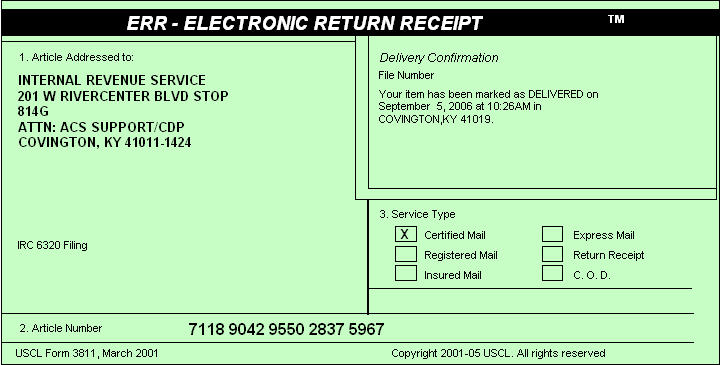
On August 23, the IRS issued final regulations on how to establish evidence of document delivery when your documents don’t actually get delivered. Basically, you need to provide proof that you sent your papers to the IRS on time with registered/certified mail through the USPS or a private delivery service.  According to the regulations, only proper use of registered or certified mail, or a service of a private delivery service will constitute prima facie evidence of delivery of documents.  The final regulations apply to any payment or document mailed or delivered in an envelope with a postmark dated after Sept. 21, 2004 (not a misprint – 2004). 
 
That means no more midnight run to the post office seconds before the taxes are due.  Your tax return may be considered as late filing, since now a good ole’ postmark technically isn’t “prima facie evidence” that you mailed your documents before the deadline. 
 
You better cross your fingers and pray, when you stick that first-class stamp on your envelope, and send it with no additional proof of delivery services. So if your document gets delayed and past its due date, or the IRS never receives it at all, you’re pretty much out of luck.
 
 
On the Money,
Sufen Wang
Wang Solutions


Articles

Counting on Your Tax Refund to Pay for Tax Preparation?

In Accounting & Finances,Business,Taxes on July 9, 2011 by Sufen Wang Tagged: , , , , ,

Prepare to Be Disappointed…

Out of sight, out of mind is not always a good idea – at least when it comes to paying for your tax preparation. The IRS seems to agree. David Williams, the director of the IRS return preparer office, announced on June 28 that the Service would not pursue the option of allowing taxpayers to use a portion of their tax refund to pay for tax preparation services.

The concept was originally proposed last year and would have offered taxpayers an alternative to extra number-crunching and out-of-pocket expenses during the already-stressful tax season. However, “Since then, the IRS has conducted outreach to numerous parties, including consumer advocates and industry groups,” Williams said. “During that outreach, the IRS heard a variety of views, some supporting this additional option for consumers, with others raising operational and/or policy concerns.”

Consumer groups especially opposed the idea because “predatory tax preparers” might take advantage of the fact that a taxpayer’s refund is not as visible or accessible once it has been turned over to the preparer. They could then charge more for tax preparation without their client’s knowledge.

The Service’s decision to reject the option won’t do anything to help the headaches that arrive during tax-preparation time. On the other hand, at least taxpayers won’t have to worry about their preparers taking more than their fair share.

Just remember that tax preparation costs money, any way you look at it, and sometimes it’s best not to delay the inevitable.

On the Money,
Sufen Wang
Wang Solutions

Articles

Summer Fundraising: Know the IRS Regulations

In Taxes on June 7, 2011 by Sufen Wang Tagged: , , , , , , , , , , , , , ,

alex's lemonade stand

Alex Scott, a childhood cancer patient, raised over $1 million for children's cancer research with her lemonade stands before passing away in 2004 at the age of eight.

The weather is warming up all over the country, and kids and adults alike are getting antsy in anticipation of the summer fun that lies ahead. But for charitable organizations and groups, summer fun also means summer fundraising.

Schools, churches, and charities often take advantage of the warmer weather to put the “fun” in “fundraising” by holding events such as lemonade stands, fun run/walks, and car washes.

But whether you’re planning to raise funds or give them, it’s important to understand the IRS regulations governing the declaration of funds donated or funds collected on your 2011 taxes.

For example, the IRS states that, when you participate in a charity auction, you can only declare the amount that you give above and beyond the value of the item you’re receiving. And you can only declare charitable contributions if you itemize your deductions on Form 1040, Schedule A.

By taking the time to really understand the rules behind charitable giving and receiving, you can save yourself a lot of headache at the end of the fiscal year.

On the Money,

Sufen Wang
Wang Solutions
Articles

Goodbye, Snail Mail: The IRS Goes Electronic

In Taxes on May 17, 2011 by Sufen Wang Tagged: , , ,

snail mail

It looks like the IRS is finally catching up to the digital age.

People have been baffled for years at the IRS’ insistence on sending correspondence via snail mail, despite the fact that lost mail and extended delivery times can lead to delays in resolving taxpayer issues. But the IRS insists that security is paramount, and that e-mail simply isn’t secure enough to guarantee a taxpayer’s privacy.

But the IRS has been working on an encryption program to allow taxpayers and practitioners (i.e. accountants) to communicate securely with the IRS. They expect to start testing it in early 2012, although it’s still unclear which department or office will start using it.

Could it be that the days of fat, scary envelopes from the IRS are over? Stay tuned to find out.

On the Money,

Sufen Wang
Wang Solutions

REMEMBER: the IRS does not yet communicate by e-mail or any other electronic format. If you get any e-mail from a domain name of irs.gov, DO NOT open it. It is not from the IRS or any of its agents/offices.

Articles

Tax Document Hoarders: How Long Should I Keep My Tax Records?

In Taxes on May 3, 2011 by Sufen Wang Tagged: , , ,

documents

We’re now two weeks removed from Tax Day 2011, and, yet, there are still questions regarding our taxes lingering in our minds. Last week, we shared with you when you should expect your tax refund, and, today, we’re going to talk about another hot tax topic: document storage.

People are often conflicted when it comes to deciding whether to keep or throw away a tax-related document. On the one hand, they don’t want to throw away any important documents. On the other hand, they don’t want to wake up one day, trapped under a pile of tax documents that they didn’t really need.

In the battle between good recordkeeping and good housekeeping, it’s important to know which documents you really need to keep, and which ones you can actually afford to toss. But it’s discerning the difference that’s the hard part. Fortunately, the IRS has put together a little article to help you decide what you should keep and what you should toss.

Here are some of the highlights:

  • If you did not report income and it’s more than 25% of your filed gross income, keep records for 6 years.
  • If you filed a fraudulent return, keep records indefinitely.
  • If you did not file a return, keep records indefinitely.
  • If none of the first three apply to you (and let’s hope that they don’t!) and you owe additional tax, keep records for 3 years.
  • If you file a claim for a credit or refund after you file your return, keep records for 3 years from the date you filed your original return or 2 years from the date you filed the tax, whichever is later.
  • If you file a claim for a loss from worthless securities or a bad debt deduction, keep records for 7 years.
  • Keep all employment tax records for 4 years from the date that the tax was either due or paid, whichever is later.
  • Keep all documents related to assets (like property) until the period of limitations expires for the year in which you disposed of the property in a taxable disposition.
  • Keep non-tax-related documents until you’re sure that you don’t need them for other purposes. An insurance company might require you to keep a document for longer than the IRS might.
  • Always keep copies of your filed tax returns. They might come in handy if you ever need to file an amended return.
  • As a rule of thumb, if you’re not confident that you can throw it out, you probably shouldn’t. It’s better safe than sorry. Just be sure to invest in some neat and tidy storage organizers so that you don’t wind up trapped under a pile of your tax documents. Many people complain that their taxes are killing them, but it shouldn’t happen in this way.

    On the Money,
    Sufen Wang
    Wang Solutions

    Articles

    Show Me the Money: When Will I Get My Tax Refund?

    In Taxes on April 26, 2011 by Sufen Wang Tagged: , , , ,

    Money

    Another Tax Day has come and gone, and you’ve survived. Whether you filed your taxes the second you got all of the necessary documents or at 11:59pm on April 18th, you’re probably all asking the same question:

    “Where’s my tax refund?”

    Well, if you filed your taxes online this year, the IRS has a handy-dandy refund chart that can show you when your refund will be processed.

    refund cycle chart 2011

    For example, if you e-filed your taxes and they were accepted by the IRS on March 15th (I’m going to assume that you were all good boys and girls and filed early this year), then you should either have gotten a direct deposit on March 25th or a check was processed and mailed out to you on April 1st (no joke).

    If you check the chart and your refund should have gotten to you by now, you can head over to the IRS website to check your refund status. Be sure to have your 2011 tax return handy so that you can enter the necessary information to get your refund status. You can also call the IRS Refund Hotline at 1-800-829-1954, or the IRS TeleTax system at 1-800-829-4477.

    Once you find out the status of your refund, you can proceed from there.

    Just don’t spend it all in one place, now.

    On the Money,
    Sufen Wang
    Wang Solutions

    Articles

    The IRS’ Dirty Dozen: The Top 12 Tax Scams of 2011

    In Taxes on April 19, 2011 by Sufen Wang Tagged: , , , ,

    Ja Rule

    Rapper Ja Rule was convicted of tax evasion in March 2011.

    We’ve all heard stories about rich and famous people running afoul of the law — not because of drug use or anything particularly glamorous, but for simple tax evasion. It might seem silly to the rest of the world, but some of these celebrities make a lot of money, and that means that the taxes they pay are significantly higher.

    But celebs aren’t the only people tempted by tax scams. Middle class Americans can get sucked into these scams, too.

    The IRS (Internal Revenue Service) has compiled a list of 2011’s top tax scams. If any of these “Dirty Dozen” sound familiar to you, be sure to avoid them and the people who suggested them to you!

    • Hiding income offshore
    • Identity theft and phishing
    • Tax return preparer fraud
    • Filing false or misleading forms
    • Frivolous legal positions or arguments
    • Nontaxable Social Security benefits with exaggerated withholding credit
    • Abuse of charitable organizations and deductions
    • Abusive retirement plans
    • Disguised corporate ownership
    • Filing phony wage- or income-related returns to reduce wages to zero
    • Misuse of trusts
    • Fuel tax credit scams

    If you’re engaged in any of these, you should know that the IRS is probably onto you, and that you’ll likely be getting audited sometime in the near future.

    But if you’ve never heard of any of them and would like to avoid them in 2012, you can get full descriptions of each of these scams from the IRS.

    On the Money,
    Sufen Wang
    Wang Solutions