Archive for the ‘Accounting & Finances’ Category

Articles

Free to Make Your Own Call:

In Accounting & Finances,Business,Taxes on September 25, 2011 by Sufen Wang Tagged: , , , , ,

Personal Use of Employer-Provided Cell Phones Not Taxable

 
Feeling guilty about using the company cell phone for personal calls?  Ever wonder if you should report this benefit to the IRS?  Well, worry no more… On September 14, the IRS announced in Notice 2011-72, that business and personal use of a cell phone, given by an employer primarily for non-compensatory business reasons, is nontaxable to the employee. Yup, that fancy Blackberry you received for work-related emergencies outside the office, or to talk to clients off the clock, is an excludable – and nontaxable – fringe benefit.

So, go ahead and answer your kids’ call and let them know what you are making for dinner tonight. Your employer is footing the bill, and you will not be taxed on the personal usage portion by the IRS.  Furthermore, you don’t need to keep track of whether you’re utilizing the phone strictly for business. The IRS won’t require recordkeeping of business use from taxpayers to receive tax-free treatment on their business assigned cell phones. Accordingly, any personal use of the cell phone also doesn’t have to be accounted for and is considered a “de minimis” fringe benefit.  However, this treatment does not apply to reimbursements of unusual or excessive expenses or to reimbursements made as a substitute for a portion of the employee’s regular wages.  Also, the guidance does not apply to the provision of cell phones or reimbursement for cell-phone use that is not primarily business related; as such arrangements are generally taxable. 
 

But what happens when your employer makes you use your own cell-phone for non-compensatory business purposes? In a related release, the IRS addressed employee cash allowances for work-related use of personally-owned cell phones. The cash reimbursements of employees’ expenses for reasonable cell phone service can be treated by employers as nontaxable items. 


Finally, remember that you can’t always keep your personal and professional lives separate. Having a company cell phone doesn’t help the matter — especially when your superiors believe you are on call 24/7.  Sometimes you just have to shut down your cell phone and enjoy your personal time off the clock.


On the Money,
Sufen Wang
Wang Solutions


Articles

IRS Delivers Document Delivery Regulations:

In Accounting & Finances,Business,Taxes on September 18, 2011 by Sufen Wang Tagged: , , ,

Regular Postmark is Out the Door…


Have you ever needed to ensure a document was delivered to the IRS on or before a specific date?  How can you prove it? 
 
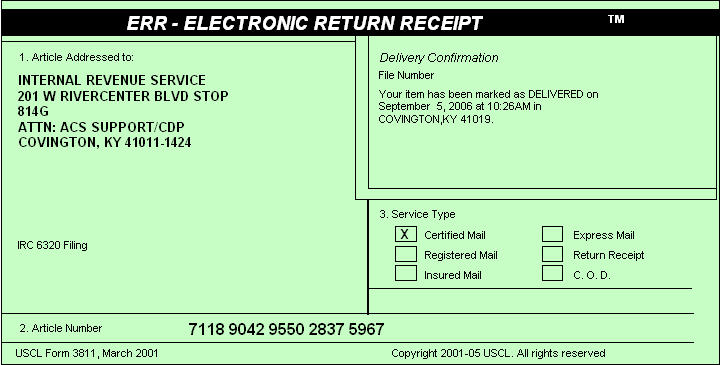
Snail mail is still alive and well in terms of sending paperwork to the IRS. So what happens when your documents – i.e. your personal tax returns due on October 15th – arrive late or don’t arrive at all to your local Department of Treasury office? Well, let’s hope you have an acceptable postal receipt as proof of delivery.
 
On August 23, the IRS issued final regulations on how to establish evidence of document delivery when your documents don’t actually get delivered. Basically, you need to provide proof that you sent your papers to the IRS on time with registered/certified mail through the USPS or a private delivery service.  According to the regulations, only proper use of registered or certified mail, or a service of a private delivery service will constitute prima facie evidence of delivery of documents.  The final regulations apply to any payment or document mailed or delivered in an envelope with a postmark dated after Sept. 21, 2004 (not a misprint – 2004). 
 
That means no more midnight run to the post office seconds before the taxes are due.  Your tax return may be considered as late filing, since now a good ole’ postmark technically isn’t “prima facie evidence” that you mailed your documents before the deadline. 
 
You better cross your fingers and pray, when you stick that first-class stamp on your envelope, and send it with no additional proof of delivery services. So if your document gets delayed and past its due date, or the IRS never receives it at all, you’re pretty much out of luck.
 
 
On the Money,
Sufen Wang
Wang Solutions


Articles

Weather the Storm:

In Accounting & Finances,Business,Insurance & Liability on September 11, 2011 by Sufen Wang Tagged: ,

Safeguard Your Financial Records against Rain, Sleet, and Snow…
 

It’s hurricane season. You have an evacuation plan, but will your financial/tax records and valuables also survive when disaster strikes?

Reconstructing records after a disaster is often essential for tax purposes, receiving federal assistance, and insurance reimbursement.

Taking the time to protect your data will save you a flood of tears when the storm clouds finally clear.

 
 The personal and business records you’ll need in order to prove your loss could be damaged – or even destroyed – in an emergency. You can safeguard your bank statements, tax returns, insurance policies, etc., by creating and frequently updating a backup set of records. This is much easier now that financial institutions provide electronic statements and make most of your financial information available online. Even if you only have paper copies of the original records, you can quickly scan these documents onto your computer.
 
Once all your information has been converted to an electronic format, just transfer it to a backup storage device, such as an external hard drive. Another option is to burn the files to a CD or DVD and create multiple copies. Along with many affordable online backup systems, many websites also offer free online storage with ample space for your electronic records; you can easily restore or access your files and keep them current with no hassle. Whether you do one or all of the above, ALWAYS insure that your data is password protected and kept in a secure location!
 
 For a full list of tips on preparing for a hurricane and other disasters…
 
check-out IR-2011-59.
 
On the Money,
Sufen Wang
Wang Solutions
 

Articles

Tax Filing Deadlines Just Ahead:

In Accounting & Finances,Business,Taxes on September 5, 2011 by Sufen Wang Tagged: , ,

IRS Gives Hurricane Victims a Break 

 
Hey procrastinators, check your calendar!  Time is running out… The Corporate Income Tax for 2010 – if you filed an extension by March 15, 2011 – is due September 15, 2011. The Personal Income Tax for 2010 – if you filed an extension by April 18, 2011 – is due October 17, 2011. Fortunately, the IRS has announced that victims of Hurricane Irene won’t be subject to these deadlines.

 
As of September 2, taxpayers living in federally-declared disaster areas in Vermont, North Carolina, New Jersey, New York, and Puerto Rico will be eligible for tax relief. The extension postpones certain tax filing and payment deadlines until Oct. 31, 2011.
 
The relief is only available to corporations/businesses that previously obtained an extension until Sept.15 for their 2010 returns, and individuals/businesses that received a similar extension until Oct. 17. The estimated tax payment for the third quarter of 2011, which would normally be due Sept. 15, is also included in the extension.
 

Even taxpayers whose preparers aren’t located in FEMA-designated disaster areas will receive some leeway from the IRS. Taxpayers whose preparers were in locales under evacuation or a severe weather warning during the hurricane, have until Sept. 22 (an extra week) to file their returns.
 

Taxpayers also get one more chance to take advantage of the Offshore Voluntary Disclosure Initiative. Due to the potential impact of Hurricane Irene, the IRS has extended the deadline from August 31 until September 9. Don’t delay, at least file for a 90 day-extension today!

 
On the Money,
Sufen Wang
Wang Solutions


Articles

The Affordable Care Act Gets a Check-Up…

In Accounting & Finances,Business,Insurance & Liability,Taxes on August 29, 2011 by Sufen Wang Tagged: , , , ,

IRS Prescribes Premium Tax Credit Regulations
 
There’s some good news and bad news this month. The good news is that the IRS proposed regulations on August 12 for health care premium tax credits – which means affordable healthcare is one step closer to becoming a reality. The bad news is that the IRS proposed regulations for health care premium tax credits – which means you might be ineligible to receive them.
 

The health insurance premium tax credits were created under the Patient Protection and Affordable Care Act (ACA) of 2010. When the ACA goes into effect in 2014, individuals who are unable to access affordable health insurance through their employers will be able to buy insurance through state-run insurance exchanges. The tax credit is geared toward lower and middle-income individuals who can’t afford to pay their premium costs out-of-pocket.

Of course, calculating the credits will be another task for tax return preparers…..

So who exactly can get the tax credit? The IRS regulations say you must be an applicable taxpayer with a household income between 100 percent and 400 percent of the federal poverty line. That’s about $22,350 to $89,400 for a family of four. Applicable also means you can’t be claimed as a dependent by another taxpayer and if you’re married, you have to file a joint return. The tax credits will average $5,000 per individual.

You also won’t be eligible if you have “minimum essential coverage” available through your employer. Under the ACA, businesses with more than 50 full-time workers over the course of a year will face tax penalties of up to $3,000 per employee if they fail to offer affordable coverage (the regulations help define affordable). Employers must report which employees are not covered by insurance and are thus eligible to participate in health insurance exchanges.

The IRS wants to hear what you think about the proposed regulations! Give them a piece of your mind by October 31:

 http://www.regulations.gov/ 

via e-mail at E-OHPSCA2715.EBSA@dol.gov.

On the Money,
Sufen Wang
Wang Solutions
 

Articles

Got Offshore Accounts? Tell the IRS by August 31 and You’ll Get Off Easy

In Accounting & Finances,Business,Taxes on August 21, 2011 by Sufen Wang Tagged: , ,

 
If you conveniently forgot about that “offshore” account you have hidden somewhere in the Bahamas, NOW is the perfect time to refresh your memory. Not only will you get a good night’s sleep when you give it up, you’ll also earn a ‘get out of jail free card’ from the IRS!
 
The 2011 Offshore Voluntary Disclosure Initiative (OVDI) is the last chance for taxpayers to inform the IRS about their undisclosed income and face less repercussions as a result.   Taxpayers who voluntarily come forward before August 31, 2011 will still have to pay a penalty, back-taxes, and interest for up to eight years. 

However, those who wait for the IRS to discover their undisclosed accounts and income – and the IRS will find them – will face much higher penalties and serious criminal charges. 
 
Taxpayers should think twice if they think they can get away with hiding their assets overseas. New foreign account reporting requirements will be phased in over the next few years, so it’s going to be even tougher to conceal income offshore. The IRS will also continue to investigate bankers and banks worldwide that assist U.S. taxpayers with overseas accounts.
 
The OVDI is a limited-time offer for taxpayers to update their taxes with the IRS, so make sure you come clean before it’s too late!
 
 
On the Money,
Sufen Wang
Wang Solutions

Articles

Counting on Your Tax Refund to Pay for Tax Preparation?

In Accounting & Finances,Business,Taxes on July 9, 2011 by Sufen Wang Tagged: , , , , ,

Prepare to Be Disappointed…

Out of sight, out of mind is not always a good idea – at least when it comes to paying for your tax preparation. The IRS seems to agree. David Williams, the director of the IRS return preparer office, announced on June 28 that the Service would not pursue the option of allowing taxpayers to use a portion of their tax refund to pay for tax preparation services.

The concept was originally proposed last year and would have offered taxpayers an alternative to extra number-crunching and out-of-pocket expenses during the already-stressful tax season. However, “Since then, the IRS has conducted outreach to numerous parties, including consumer advocates and industry groups,” Williams said. “During that outreach, the IRS heard a variety of views, some supporting this additional option for consumers, with others raising operational and/or policy concerns.”

Consumer groups especially opposed the idea because “predatory tax preparers” might take advantage of the fact that a taxpayer’s refund is not as visible or accessible once it has been turned over to the preparer. They could then charge more for tax preparation without their client’s knowledge.

The Service’s decision to reject the option won’t do anything to help the headaches that arrive during tax-preparation time. On the other hand, at least taxpayers won’t have to worry about their preparers taking more than their fair share.

Just remember that tax preparation costs money, any way you look at it, and sometimes it’s best not to delay the inevitable.

On the Money,
Sufen Wang
Wang Solutions

Articles

Rates Increased?! That’s A Good Thing!!!

In Accounting & Finances,Business on July 1, 2011 by Sufen Wang Tagged: ,

There are many, many things that make us loathe driving around and exhausting our miles when we’re on the clock: other drivers, traffic, the cost of gas. The IRS have noticed that gas prices are killing our wallets and have decided to act. Beginning July 1 and lasting through the remainder of 2011, the optional standard mileage rates are being increased to 55.5 cents per mile for business miles driven. It is a slight increase in what drivers can be reimbursed for, but these things add up.  

Traditionally, the IRS only revises these rates once a year – during the fall and having them take effect for the following calendar year. They have wavered from this and have decided to help us out now, reacting to the increasing cost of fuel with these semi-annual new rates. Will it help? Somewhat. The changed rates count towards expenses for miles driven on business purposes as well as those for moving or medical expenses, which were also raised to 23.5 cents per mile.
 
The ever-present complaint is about the cost of gas. Well, the amount we can be reimbursed went up a little. Hooray! Now if they could just do something about that traffic.

On the Money,
Sufen Wang
Wang Solutions

Articles

Going Rogue:

In Accounting & Finances,Business,Taxes on May 11, 2011 by Sufen Wang Tagged: , , , , , ,

The Risks and Responsibilities of Hiring Independent Contractors


America: it’s the land of the free and the home of the brave. We Americans pride ourselves on our independence, and, now, with the economy still slowly making its way towards recovery, more businesses are hiring independent contractors than ever, and more people are working as independent contractors than ever.

I recently came across this article by Ronda Jones of Forrest T. Jones & Company. It’s all about what you need to know before you hire an independent contractor or accept work as an independent contractor. It’s a helpful article, and if you’re thinking about hiring an independent contractor, you should definitely give it a read. But here are some tidbits to whet your appetite.

If you’re thinking about hiring an independent contractor:

    • Consult an attorney and draw up a basic work contract. Make sure that it includes a “hold harmless” clause, a non-competition clause, and insurance clauses, and make sure that it addresses jurisdictional issues in your city and state.
    • Make sure that the independent contractor has adequate insurance to cover their work.
    • Consult your insurance agent to see how hiring an independent contractor will affect your coverage.
    • Request and retain invoices from your contractor.
    • You may also want to run a background check or even run an internet search to make sure that there aren’t any unpleasant surprises in store for you.
    • Make sure that you know how to issue Form 1099-MISC at the end of each tax year for your contractor.

If you are working as an independent contractor:

  • Review the company’s independent work contract. You may want to have your attorney go over it to make sure that it’s okay to sign. Make sure that you are only held accountable for liabilities resulting from gross negligence or willful misconduct. You may also want to insert a liability limitation cap so that you aren’t still held liable for errors or omissions that are discovered years down the line.
  • Ask the employer for copies of their certificates of insurance so that you can make sure that they have general liability and auto liability insurance, if applicable. You should also ask to be listed under their professional liability or errors & omissions insurance, if applicable.
  • Keep a log of the projects you’ve worked on, just in case your involvement is ever called into question.

Ask the contractor periodically to meet and review the terms of the contract to make sure that it adequately covers the work that you’re actually being required to do.Working with an independent contractor is a great way to save money for services you need, compared to hiring someone full-time that you don’t really need full-time. Working as an independent contractor is a great way to get work during times when work is difficult to find.

And if you go about it the right way, then neither party will have to hire Chuck Norris to take out the other.

  • On the Money,
    Sufen Wang
    Wang Solutions