Posts Tagged ‘Tax’

Articles

IRS Delivers Document Delivery Regulations:

In Accounting & Finances,Business,Taxes on September 18, 2011 by Sufen Wang Tagged: , , ,

Regular Postmark is Out the Door…


Have you ever needed to ensure a document was delivered to the IRS on or before a specific date?  How can you prove it? 
 
Snail mail is still alive and well in terms of sending paperwork to the IRS. So what happens when your documents – i.e. your personal tax returns due on October 15th – arrive late or don’t arrive at all to your local Department of Treasury office? Well, let’s hope you have an acceptable postal receipt as proof of delivery.
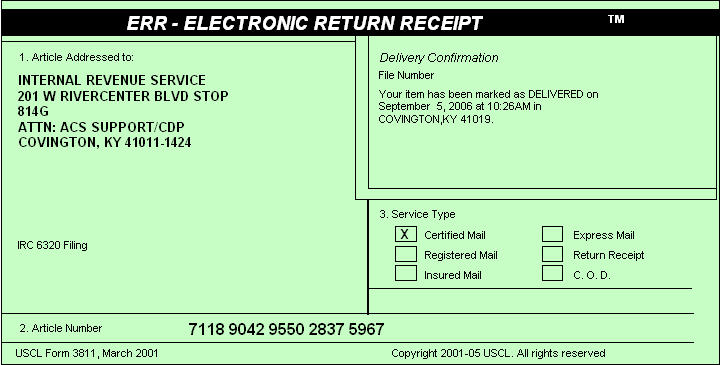
 
On August 23, the IRS issued final regulations on how to establish evidence of document delivery when your documents don’t actually get delivered. Basically, you need to provide proof that you sent your papers to the IRS on time with registered/certified mail through the USPS or a private delivery service.  According to the regulations, only proper use of registered or certified mail, or a service of a private delivery service will constitute prima facie evidence of delivery of documents.  The final regulations apply to any payment or document mailed or delivered in an envelope with a postmark dated after Sept. 21, 2004 (not a misprint – 2004). 

 
That means no more midnight run to the post office seconds before the taxes are due.  Your tax return may be considered as late filing, since now a good ole’ postmark technically isn’t “prima facie evidence” that you mailed your documents before the deadline. 
 
You better cross your fingers and pray, when you stick that first-class stamp on your envelope, and send it with no additional proof of delivery services. So if your document gets delayed and past its due date, or the IRS never receives it at all, you’re pretty much out of luck.
 
 
On the Money,
Sufen Wang
Wang Solutions



Articles

Tax Filing Deadlines Just Ahead:

In Accounting & Finances,Business,Taxes on September 5, 2011 by Sufen Wang Tagged: , ,

IRS Gives Hurricane Victims a Break 

 
Hey procrastinators, check your calendar!  Time is running out… The Corporate Income Tax for 2010 – if you filed an extension by March 15, 2011 – is due September 15, 2011. The Personal Income Tax for 2010 – if you filed an extension by April 18, 2011 – is due October 17, 2011. Fortunately, the IRS has announced that victims of Hurricane Irene won’t be subject to these deadlines.

 
As of September 2, taxpayers living in federally-declared disaster areas in Vermont, North Carolina, New Jersey, New York, and Puerto Rico will be eligible for tax relief. The extension postpones certain tax filing and payment deadlines until Oct. 31, 2011.
 
The relief is only available to corporations/businesses that previously obtained an extension until Sept.15 for their 2010 returns, and individuals/businesses that received a similar extension until Oct. 17. The estimated tax payment for the third quarter of 2011, which would normally be due Sept. 15, is also included in the extension.
 

Even taxpayers whose preparers aren’t located in FEMA-designated disaster areas will receive some leeway from the IRS. Taxpayers whose preparers were in locales under evacuation or a severe weather warning during the hurricane, have until Sept. 22 (an extra week) to file their returns.
 

Taxpayers also get one more chance to take advantage of the Offshore Voluntary Disclosure Initiative. Due to the potential impact of Hurricane Irene, the IRS has extended the deadline from August 31 until September 9. Don’t delay, at least file for a 90 day-extension today!

 
On the Money,
Sufen Wang
Wang Solutions


Articles

Got Offshore Accounts? Tell the IRS by August 31 and You’ll Get Off Easy

In Accounting & Finances,Business,Taxes on August 21, 2011 by Sufen Wang Tagged: , ,

 
If you conveniently forgot about that “offshore” account you have hidden somewhere in the Bahamas, NOW is the perfect time to refresh your memory. Not only will you get a good night’s sleep when you give it up, you’ll also earn a ‘get out of jail free card’ from the IRS!
 
The 2011 Offshore Voluntary Disclosure Initiative (OVDI) is the last chance for taxpayers to inform the IRS about their undisclosed income and face less repercussions as a result.   Taxpayers who voluntarily come forward before August 31, 2011 will still have to pay a penalty, back-taxes, and interest for up to eight years. 
However, those who wait for the IRS to discover their undisclosed accounts and income – and the IRS will find them – will face much higher penalties and serious criminal charges. 
 
Taxpayers should think twice if they think they can get away with hiding their assets overseas. New foreign account reporting requirements will be phased in over the next few years, so it’s going to be even tougher to conceal income offshore. The IRS will also continue to investigate bankers and banks worldwide that assist U.S. taxpayers with overseas accounts.
 
The OVDI is a limited-time offer for taxpayers to update their taxes with the IRS, so make sure you come clean before it’s too late!
 
 
On the Money,
Sufen Wang
Wang Solutions

Articles

Counting on Your Tax Refund to Pay for Tax Preparation?

In Accounting & Finances,Business,Taxes on July 9, 2011 by Sufen Wang Tagged: , , , , ,

Prepare to Be Disappointed…

Out of sight, out of mind is not always a good idea – at least when it comes to paying for your tax preparation. The IRS seems to agree. David Williams, the director of the IRS return preparer office, announced on June 28 that the Service would not pursue the option of allowing taxpayers to use a portion of their tax refund to pay for tax preparation services.

The concept was originally proposed last year and would have offered taxpayers an alternative to extra number-crunching and out-of-pocket expenses during the already-stressful tax season. However, “Since then, the IRS has conducted outreach to numerous parties, including consumer advocates and industry groups,” Williams said. “During that outreach, the IRS heard a variety of views, some supporting this additional option for consumers, with others raising operational and/or policy concerns.”

Consumer groups especially opposed the idea because “predatory tax preparers” might take advantage of the fact that a taxpayer’s refund is not as visible or accessible once it has been turned over to the preparer. They could then charge more for tax preparation without their client’s knowledge.

The Service’s decision to reject the option won’t do anything to help the headaches that arrive during tax-preparation time. On the other hand, at least taxpayers won’t have to worry about their preparers taking more than their fair share.

Just remember that tax preparation costs money, any way you look at it, and sometimes it’s best not to delay the inevitable.

On the Money,
Sufen Wang
Wang Solutions