
In Accounting & Finances, Business, Taxes on October 30, 2011 by Sufen Wang Tagged: Death, Executor, Internal Revenue Service, irs, Nov. 15 2011, Tax, Tax return (United States), United States
 Think Taxes Will Be the Death of You?…. Well, Death Isn’t the End of Taxes…
 Having trouble resting in peace? Do you feel that something is gravely wrong? Concerned about skeletons in your closet? You could be suffering from more than just Halloween fever – you might be haunted by the fact that you need to file that “LAST” tax return after your death!
Yes, you read that right: death does not excuse a final accounting with the IRS. Death and taxes may be equally inevitable, but the taxman demands the last word, and the return is due by April 15 of the year following the taxpayer’s death. The estate tax return for a decedent who died after Dec. 16, 2010 is due nine months after the date of the decedent’s death.
However, if you died between Dec. 31, 2009 and Dec. 17, 2010, you’re in luck! The IRS decided to automatically grant filing extensions, as long as the executor timely files Form 4768. That means no late filing and payment penalties on estates of decedents who submit Form 706 or 706-NA and pay the estate tax by March 19, 2012.
 The IRS is offering another treat this Halloween season! The due date for Basis Form 8939 – an information return used to report information about property acquired from a decedent and to allocate basis increase to certain property acquired from a decedent. – has been changed from Nov. 15, 2011 to Jan. 17, 2012. The IRS will not issue another extension and an executor may only file an amended Form 8939 by July 17, 2012 if the provisions of § 301.9100-2(b) are satisfied.
 The IRS has one more trick in its bag. Notice 2011-76 also provides penalty relief for certain beneficiaries of estates on their 2010 federal income tax returns. Usually the property recipient will be penalized if they don’t pay taxes on what they received – unless their neglect is due to a reasonable cause. Now, the IRS will presume that the recipient’s failure to pay was due to a reasonable cause; the recipient just needs to write “IRS Notice 2011-76” across the top of their amended return.
 By the way, one last word, you really should “supervise” your executor to ensure that he/she files the extension on time and avoids any penalties. Not that it matters, since you personally do not have to worry about paying the extra dough!
On the Money,
Sufen Wang
Wang Solutions
In Accounting & Finances, Business, Taxes on October 23, 2011 by Sufen Wang Tagged: Circular 230, Internal Revenue Service, irs, Preparer Tax Identification Number, PTIN, Tax, Tax preparation, Tax returns
The IRS says Nobody Can Claim the Name – Just Yet

Think you have what it takes to be called a Registered Tax Return Preparer (RTRP)? At the moment, nobody does! In case you missed it, the IRS issued a reminder that NO ONE can currently claim to be a “Registered Tax Return Preparer,” even if they have a provisional preparer tax identification number (PTIN).
Cutting corners (and words) by calling yourself a “Registered Return Preparer” or “Registered Tax Preparer” isn’t going to cut it either. In order to become an official RTRP, an individual must have a valid PTIN, complete 15 units of continuing education, pass the IRS competency examination, and also pass the tax compliance and suitability checks. Sounds simple enough – except for the fact that the examination is not yet available and the IRS is still developing the suitability check!
 Although the IRS released the specifications for the exam, the agency hasn’t stated when the test and the check will be up and running. Since NOBODY can satisfy all four of the RTRP requirements, at this point, NOBODY may designate her/himself as a registered tax return preparer. That means EAs, CPAs, and other individuals exempt from taking the IRS competency examination and the 15 education units shouldn’t print “Registered Tax Return Preparer” on their business cards either.
Don’t turn a blind eye to these IRS requirements– especially since all 730,000 PTIN holders are subject to the advertising and solicitation rules under section 10.30 of Circular 230. Advertising yourself as an RTRP when you really aren’t registered could result in a trip to the Office of Professional Responsibility, a monetary penalty, and even a disqualification from the practice. Now stop reading and go study and get ready for the IRS upcoming competency exam!
So, folks, don’t get fool by titles or advertised names, check out your tax preparer’s credential before you acquire the services.
On the Money,
Sufen Wang
Wang Solutions
In Accounting & Finances, Business, Taxes on October 16, 2011 by Sufen Wang Tagged: Drought, Internal Revenue Service, Livestock, Tax, Texas
 IRS Extends Livestock Replacement Period….
First hurricanes, now drought – when will the bad weather end? The IRS is doing what it can to ensure that livestock businesses don’t become dead-meat in the heat. On Sept. 21, the agency announced in Notice 2011-79 that it was extending the replacement period for livestock involuntarily sold because of the drought.
 The IRS issued the extension under Tax code Section 1033. This tax code allows a taxpayer to defer any taxes due to a gain on the sale of livestock – if that livestock is both involuntarily converted and replaced with property similar in service or use. A breeder who sold more dairy cows than usual because the animals didn’t have enough water or grass, will have four years to replace those extra cows he sold if he wants to delay paying taxes on his profit. (Assuming there is a profit!) Notice 2011-79 extends the start of this replacement period to the end of the taxpayer’s first taxable year without drought for the applicable region.
 Texas has been hit the hardest by the dry skies, but “applicable region” refers to any United States county experiencing drought on account of which livestock was sold or exchanged, and all counties adjacent to it. The region needs to have experienced exceptional, extreme, or severe conditions. Moreover, while the consequences of the weather must spark the livestock exchange, the actual sale doesn’t need to occur in the affected area.
The IRS notice listed counties and parishes in 32 states, for which drought has been reported in the last twelve months, and which are eligible for relief. Taxpayers can also refer to the U.S. Drought Monitor to determine the extent of drought reported for any location in the applicable region. The extension should help many Americans survive the dry spell so that when April showers (and taxes) finally arrive, they can return to business as usual.
 On the Money,
Sufen Wang
Wang Solutions
In Accounting & Finances, Business, Taxes on October 9, 2011 by Sufen Wang Tagged: Harborside, Internal Revenue Service, irs, Medical cannabis, Tax
 IRS Denies Tax Deductions for Dispensaries
The IRS recently got involved in the medical marijuana business – that is, to inform lawmakers on how to deal with expense deductions when it comes to dispensing medical marijuana. The confusion buds from the fact that medical marijuana is legal and generates tax-revenue in fifteen states, but the product is technically illegal under federal law. And guess what, the IRS is federal; therefore, in short, the IRS “smoked” the medical marijuana dispensaries.
Lawmakers wanted the inside dope from the IRS on whether taxpayers who grow and/or sell marijuana for medical purposes may take a deduction for their business expenses. These are standard expenses, such as rent and payroll, which other industries normally deduct. They noted that tax code Section 280E was enacted in 1982 to deny deductions to individuals trafficking in illegal drugs, but state laws have changed in the meantime and many now permit the sale of marijuana for medical purposes.
 The IRS dished-out its ruling in a series of identical letters to the lawmakers. The agency also cited Section 280E, specifically that it “disallows deductions incurred in the trade or business of trafficking in controlled substances that federal law or the law of any state in which the taxpayer conducts the business prohibits.” However, the IRS pointed out that marijuana is a controlled substance, as defined under the federal Controlled Substances Act – which basically means that pot dispensaries need to pay taxes, but they can’t receive deductions while they sell a federally prohibited drug.
The IRS also emphasized that medical marijuana doesn’t get special treatment over other substances. The letter refers lawmakers to United States v. Oakland Cannabis Buyers’ Cooperative, in which the U.S. Supreme Court ruled that medically necessary marijuana is still marijuana and thus, still a controlled substance. Pot is pot, even if it calls the kettle full of other illegal drugs black, and so the dispensaries that sell it won’t receive tax deductions.
 The ruling is already being acted upon and affects more than just hole-in-the-wall dispensaries – we’re talking big money here. The largest medical marijuana dispensary in the west –Harborside Health Center in Oakland – made over $22 million dollars last year. Just last week, Harborside received a letter from the IRS stating that they can’t deduct standard business expenses and now owe $2.5 million in taxes from 2007 and 2008 – on top of the $2 million they already paid for those years. Saying no to deductions is just the beginning, but it could mean the end of medical marijuana dispensaries.
On the Money,
Sufen Wang
Wang Solutions
In Accounting & Finances, Business, Taxes on September 30, 2011 by Sufen Wang Tagged: H&R Block, HSBC, Internal Revenue Service, Loan, Refund anticipation loan, Tax
 Fast cash from H&R Block after filing taxes is a thing of the past. H&R Block’s Refund Anticipation Loans (RALs) provided quick money for millions of Americans, who don’t have bank accounts to receive speedy tax refund direct deposits from the IRS. Since they need their tax refunds immediately, they opted to get RALs from H&R Block during the waiting period, even though the interest rates would cost them an arm and a leg. Well, now customers will need to take their business elsewhere: H&R Block announced on September 13 that it won’t offer such loans for the 2012 tax filing season.

Cobb left out some important information. In December 2010, the IRS decided it would no longer help banks underwrite tax refund loans, due to the concern over exorbitant interest rates. In 2011, H&R Block stopped offering refund anticipation loans because U.S. regulators directed the company’s third-party lending bank, HSBC, to quit funding the product. Interestingly, H&R Block’s fiscal fourth quarter profit fell almost 4.9 % when the service was cut.
H&R Block said it still expects to provide “low-cost financial solutions” during the 2012 filing season, but didn’t specify what those solutions might be. Refund anticipation checks are a viable alternative for customers, although they don’t provide the cash as quickly as a loan. Jackson Hewitt Tax Service Inc. and Liberty Tax Service apparently still offer refund anticipation loans, but customers should anticipate saying farewell to RALs from all companies in the near future.
On the Money,
Sufen Wang
Wang Solutions
In Accounting & Finances, Business, Taxes on September 25, 2011 by Sufen Wang Tagged: business, Cash Reimbursements, Cellphone Usage, Internal Revenue Service, irs, Tax
 Personal Use of Employer-Provided Cell Phones Not Taxable
Feeling guilty about using the company cell phone for personal calls? Ever wonder if you should report this benefit to the IRS? Well, worry no more… On September 14, the IRS announced in Notice 2011-72, that business and personal use of a cell phone, given by an employer primarily for non-compensatory business reasons, is nontaxable to the employee. Yup, that fancy Blackberry you received for work-related emergencies outside the office, or to talk to clients off the clock, is an excludable – and nontaxable – fringe benefit.
 So, go ahead and answer your kids’ call and let them know what you are making for dinner tonight. Your employer is footing the bill, and you will not be taxed on the personal usage portion by the IRS. Furthermore, you don’t need to keep track of whether you’re utilizing the phone strictly for business. The IRS won’t require recordkeeping of business use from taxpayers to receive tax-free treatment on their business assigned cell phones. Accordingly, any personal use of the cell phone also doesn’t have to be accounted for and is considered a “de minimis” fringe benefit. However, this treatment does not apply to reimbursements of unusual or excessive expenses or to reimbursements made as a substitute for a portion of the employee’s regular wages. Also, the guidance does not apply to the provision of cell phones or reimbursement for cell-phone use that is not primarily business related; as such arrangements are generally taxable.
But what happens when your employer makes you use your own cell-phone for non-compensatory business purposes? In a related release, the IRS addressed employee cash allowances for work-related use of personally-owned cell phones. The cash reimbursements of employees’ expenses for reasonable cell phone service can be treated by employers as nontaxable items.

Finally, remember that you can’t always keep your personal and professional lives separate. Having a company cell phone doesn’t help the matter — especially when your superiors believe you are on call 24/7. Sometimes you just have to shut down your cell phone and enjoy your personal time off the clock.
On the Money,
Sufen Wang
Wang Solutions
In Accounting & Finances, Business, Taxes on September 18, 2011 by Sufen Wang Tagged: irs, Mail, Tax, Tax return (United States)
 Regular Postmark is Out the Door…
Have you ever needed to ensure a document was delivered to the IRS on or before a specific date? How can you prove it?
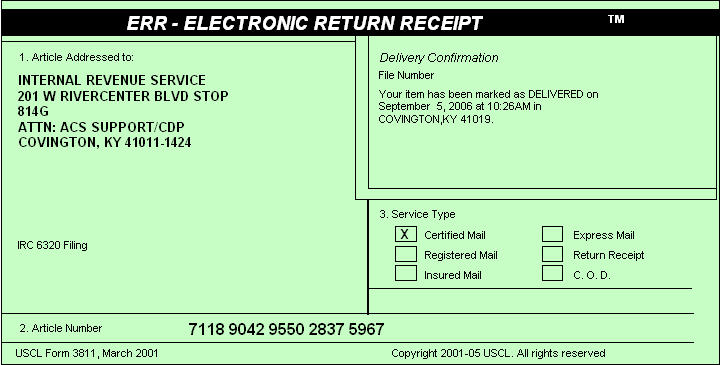
Snail mail is still alive and well in terms of sending paperwork to the IRS. So what happens when your documents – i.e. your personal tax returns due on October 15th – arrive late or don’t arrive at all to your local Department of Treasury office? Well, let’s hope you have an acceptable postal receipt as proof of delivery.
 On August 23, the IRS issued final regulations on how to establish evidence of document delivery when your documents don’t actually get delivered. Basically, you need to provide proof that you sent your papers to the IRS on time with registered/certified mail through the USPS or a private delivery service. According to the regulations, only proper use of registered or certified mail, or a service of a private delivery service will constitute prima facie evidence of delivery of documents. The final regulations apply to any payment or document mailed or delivered in an envelope with a postmark dated after Sept. 21, 2004 (not a misprint – 2004).
 That means no more midnight run to the post office seconds before the taxes are due. Your tax return may be considered as late filing, since now a good ole’ postmark technically isn’t “prima facie evidence” that you mailed your documents before the deadline.
You better cross your fingers and pray, when you stick that first-class stamp on your envelope, and send it with no additional proof of delivery services. So if your document gets delayed and past its due date, or the IRS never receives it at all, you’re pretty much out of luck.
On the Money,
Sufen Wang
Wang Solutions
In Accounting & Finances, Business, Insurance & Liability on September 11, 2011 by Sufen Wang Tagged: Backup, Emergency evacuation
Safeguard Your Financial Records against Rain, Sleet, and Snow…
 It’s hurricane season. You have an evacuation plan, but will your financial/tax records and valuables also survive when disaster strikes?
Reconstructing records after a disaster is often essential for tax purposes, receiving federal assistance, and insurance reimbursement.
Taking the time to protect your data will save you a flood of tears when the storm clouds finally clear.
 The personal and business records you’ll need in order to prove your loss could be damaged – or even destroyed – in an emergency. You can safeguard your bank statements, tax returns, insurance policies, etc., by creating and frequently updating a backup set of records. This is much easier now that financial institutions provide electronic statements and make most of your financial information available online. Even if you only have paper copies of the original records, you can quickly scan these documents onto your computer.
 Once all your information has been converted to an electronic format, just transfer it to a backup storage device, such as an external hard drive. Another option is to burn the files to a CD or DVD and create multiple copies. Along with many affordable online backup systems, many websites also offer free online storage with ample space for your electronic records; you can easily restore or access your files and keep them current with no hassle. Whether you do one or all of the above, ALWAYS insure that your data is password protected and kept in a secure location!
For a full list of tips on preparing for a hurricane and other disasters…
On the Money,
Sufen Wang
Wang Solutions
In Accounting & Finances, Business, Taxes on September 5, 2011 by Sufen Wang Tagged: Federal Emergency Management Agency, Internal Revenue Service, Tax
 IRS Gives Hurricane Victims a Break
Hey procrastinators, check your calendar! Time is running out… The Corporate Income Tax for 2010 – if you filed an extension by March 15, 2011 – is due September 15, 2011. The Personal Income Tax for 2010 – if you filed an extension by April 18, 2011 – is due October 17, 2011. Fortunately, the IRS has announced that victims of Hurricane Irene won’t be subject to these deadlines.
 As of September 2, taxpayers living in federally-declared disaster areas in Vermont, North Carolina, New Jersey, New York, and Puerto Rico will be eligible for tax relief. The extension postpones certain tax filing and payment deadlines until Oct. 31, 2011.
The relief is only available to corporations/businesses that previously obtained an extension until Sept.15 for their 2010 returns, and individuals/businesses that received a similar extension until Oct. 17. The estimated tax payment for the third quarter of 2011, which would normally be due Sept. 15, is also included in the extension.

Even taxpayers whose preparers aren’t located in FEMA-designated disaster areas will receive some leeway from the IRS. Taxpayers whose preparers were in locales under evacuation or a severe weather warning during the hurricane, have until Sept. 22 (an extra week) to file their returns.

Taxpayers also get one more chance to take advantage of the Offshore Voluntary Disclosure Initiative. Due to the potential impact of Hurricane Irene, the IRS has extended the deadline from August 31 until September 9. Don’t delay, at least file for a 90 day-extension today!
On the Money,
Sufen Wang
Wang Solutions
In Accounting & Finances, Business, Insurance & Liability, Taxes on August 29, 2011 by Sufen Wang Tagged: ACA, Affordable Care Act, insurance, Internal Revenue Service, Patient Protection and Affordable Care Act
 IRS Prescribes Premium Tax Credit Regulations
There’s some good news and bad news this month. The good news is that the IRS proposed regulations on August 12 for health care premium tax credits – which means affordable healthcare is one step closer to becoming a reality. The bad news is that the IRS proposed regulations for health care premium tax credits – which means you might be ineligible to receive them.
The health insurance premium tax credits were created under the Patient Protection and Affordable Care Act (ACA) of 2010. When the ACA goes into effect in 2014, individuals who are unable to access affordable health insurance through their employers will be able to buy insurance through state-run insurance exchanges. The tax credit is geared toward lower and middle-income individuals who can’t afford to pay their premium costs out-of-pocket.
 Of course, calculating the credits will be another task for tax return preparers…..
So who exactly can get the tax credit? The IRS regulations say you must be an applicable taxpayer with a household income between 100 percent and 400 percent of the federal poverty line. That’s about $22,350 to $89,400 for a family of four. Applicable also means you can’t be claimed as a dependent by another taxpayer and if you’re married, you have to file a joint return. The tax credits will average $5,000 per individual.
You also won’t be eligible if you have “minimum essential coverage” available through your employer. Under the ACA, businesses with more than 50 full-time workers over the course of a year will face tax penalties of up to $3,000 per employee if they fail to offer affordable coverage (the regulations help define affordable). Employers must report which employees are not covered by insurance and are thus eligible to participate in health insurance exchanges.
 The IRS wants to hear what you think about the proposed regulations! Give them a piece of your mind by October 31:
http://www.regulations.gov/
via e-mail at E-OHPSCA2715.EBSA@dol.gov.
On the Money,
Sufen Wang
Wang Solutions
 Think Taxes Will Be the Death of You?…. Well, Death Isn’t the End of Taxes…
 Having trouble resting in peace? Do you feel that something is gravely wrong? Concerned about skeletons in your closet? You could be suffering from more than just Halloween fever – you might be haunted by the fact that you need to file that “LAST” tax return after your death!
 The IRS is offering another treat this Halloween season! The due date for Basis Form 8939 – an information return used to report information about property acquired from a decedent and to allocate basis increase to certain property acquired from a decedent. – has been changed from Nov. 15, 2011 to Jan. 17, 2012. The IRS will not issue another extension and an executor may only file an amended Form 8939 by July 17, 2012 if the provisions of § 301.9100-2(b) are satisfied.
 The IRS has one more trick in its bag. Notice 2011-76 also provides penalty relief for certain beneficiaries of estates on their 2010 federal income tax returns. Usually the property recipient will be penalized if they don’t pay taxes on what they received – unless their neglect is due to a reasonable cause. Now, the IRS will presume that the recipient’s failure to pay was due to a reasonable cause; the recipient just needs to write “IRS Notice 2011-76” across the top of their amended return.
 By the way, one last word, you really should “supervise” your executor to ensure that he/she files the extension on time and avoids any penalties. Not that it matters, since you personally do not have to worry about paying the extra dough!























 Wang Solutions