Archive for the ‘Taxes’ Category

In Accounting & Finances,Business,Taxes on December 14, 2011 by Sufen Wang Tagged: Calendar year, Internal Revenue Service, IRS tax forms, Payment, Property tax, Salvation Army, Tax, Tax preparation
The end of the year is almost here and it’s the perfect time for business owners and individual tax payers to dust off their financial documents and confirm that everything is in order. You’ve got a lot to do, so let’s get started before those April tax showers come storming in!
Business Owners:
You’ll need to review all of your vendor payouts for the year: any vendor who has provided you labor services for more than $600 must be reported to the IRS via Form 1099. As a rule of thumb, always ask your vendors, regardless of the amount of their services, to complete a new W9 at the beginning of each calendar year; so that you do not have to chase them at year end for information. The W9 provides their legal name, address, and tax payer ID – whether it’s an EIN number or a regular social security number – and also requires the vendor to claim responsibility for any taxes due from payments issued to him.
Check your payroll to ensure payments to your employees have been recorded correctly throughout the year, any corrections may be still processed onto their year-end W2’s. Also, make sure that your payroll taxes have been submitted to the proper governmental agencies on a timely basis, and better take care any late payment before you close your books for the year. Any year-end bonuses and/or profit sharing to officers and employees must also be processed and to be included in their individual W2’s, and recorded as business expense accordingly.

Review your retirement plan, i.e, 401k Plan, if you have one. Make sure that all of the employees’ deferral have been deposited into their accounts; and any and all profit sharing or employer matching funds have been accurately distributed accordingly.The good news is that those profit sharing and/or employer matching distributions within a retirement plan are actually business write-offs and can help ease your year-end tax liability!
Take the time to reconcile your business checking and money market accounts with their corresponding bank statements – that means making sure the interest income has been recorded. Then move on to your credit card accounts and verify any and all business related charges and finance fees are in the record books. You should do the same with your cash expenses (i.e. count the petty cash drawer one last time) and dig out those receipts you knew would come in handy to support any expenditures.
Moreover, any capital expenditures? Section 179 will allow you to deduct a large amount of assets (expenditures) that you purchased throughout the year for business use. Again, make sure you have the proper receipts and purpose of the equipment clearly stated for your tax preparer.

Last but not least, the company cars are going to require a little inspection. Always reexamine the mileage log and odometer of what are supposed to be strictly business-used vehicles; your tax preparer will need this information to complete your business tax returns.
Individual Tax Payers:
Now where did you put those year-end W2’s? Your tax preparer will ask you for them, along with childcare-related expenses, and interest income received and mortgage payment 1098’s from your financial institutions. Keep an eye out because these documents must arrive on your doorstep by January 31. Next is the numbered forms category, check for 1099’s received from your investment accounts, such as mutual funds dividends and/or interest received for the year, and any stocks sold with their proper gain or loss data.
 You can deduct any charitable donations you made during the year. Unfortunately, this does not include the time you spent doing laundry and taking the kids to school. Most charity organizations will issue a year-end summary of funds received from you by January 31. Any other small donations to Goodwill, Salvation Army, etc. must have a receipt with a description of the donated items and their estimated value.
To all the homeowners out there, do yourself a favor and confirm that you recorded your property tax payments. If you own rental properties, be sure that the collected rent has been properly documented as income, and related expenditures noted as rental expenses – this should include the property taxes you paid in the calendar year. While you’re searching through your “Property” file, if you refinanced, purchased, or sold any real estate this year, set aside your final closing document issued from the escrow company for your tax preparer. Please note that this must be the final closing statement and NOT the estimated statements.
Finally, gather up all of your medical expenses, doctors and medicine expenses alike. They are tax deductible if you are filing itemized personal income tax returns. Make sure you have the proper receipts to support your claims. Dont’ forget those glasses and dental appointments you had throughout the year!
Now you’re ready to welcome in the new year with a (temporarily) clean filing cabinet!
 On the Year End,
Sufen Wang
Wang Solutions
In Accounting & Finances,Business,Education,Taxes on November 21, 2011 by Sufen Wang Tagged: accounting, business, Education, Internal Revenue Service, irs, Small business, Tax, United States
 Get Schooled by the IRS for Free
Wall Street isn’t the only place that’s been occupied lately. Proposed tuition increases have caused students on college campuses across the U.S. to stand up and say “NO” to raising the cost of higher education. If attending a university will break your bank, the IRS has a solution: the agency offers a variety of excellent educational training and learning tools for small businesses for FREE……
Those of you who consider yourselves tax pros should check out IRS Live. A real-time webinar, IRS Live is a panel discussion among IRS experts and industry professionals aimed at educating tax professionals on current and complex tax issues affecting them and their clients. You can actually earn Continuing Professional Education credits for participating in the webinar! IRS Live is broadcast bimonthly and the next program airs on Dec. 14.
 For small business owners who are too busy to hit the books can boost their knowledge by visiting the Small Business/Self-Employed Virtual Small Business Tax Workshop. The curriculum caters to new owners and features lessons about how to set up and run your business so paying taxes isn’t a hassle, what you need to know about Federal Taxes and your new business, and much more. The best part is that you can go to recess whenever you get tired of listening to the teacher talk about retirement plans and tax obligations.
While you’re on the computer, you should print the handy-dandy 2012 tax calendar for small businesses and the self-employed, or set it as your desktop wallpaper. It reminds you about everything from the exact days you should deposit your payroll tax, to what forms you need to file and when. Or, if you’re an avid reader and don’t want to get too lost in that novel, just order a tax information bookmark – or even 100 if you want one for every book! You can go shopping for other business products here, and remember, everything is always free from the IRS.
 Brochures are nice, but could you spot a tax scammer walking down the street? The IRS even provides tools to help identify, avoid, and report different types of scams. Still can’t get enough? Whether you’re a teacher looking to freshen up those old lesson plans or just somebody who wants to become more proficient in the business world, Understanding Taxes is a gold mine of educational resources. It provides detailed lesson plans, interactive activities, simulations, and answers for the hows and whys of taxes. The only thing the IRS doesn’t give you is an apple for the teacher.
On the Money,
Sufen Wang
Wang Solutions
In Accounting & Finances,Taxes on November 6, 2011 by Sufen Wang Tagged: Audit, Budget, Douglas Shulman, Internal Revenue Service, irs, Senate, Tax
 Speaking up for the IRS….
Although taxpayers send their returns and payments to the IRS, the agency isn’t exactly rolling in the dough. Yes, the IRS has a budget and, what’s more, it’s in danger of being reduced. Don’t jump for joy yet; less money for the IRS could mean more problems for taxpayers in the near future.
IRS Commissioner Douglas Shulman broke down the implications of a broke IRS in a letter he recently sent to key lawmakers. The IRS budget last year was $12.1 billion: a current House approbation bill wants to cut $650 million from core IRS accounts and a Senate bill proposes a $525 million cut. Shulman stated outright that “These budget cuts will result in a direct increase to the nation’s deficit.”
 But how could a decrease in government spending increase the deficit? For starters, “The IRS is unique in that it has a positive return on investment…collecting on average $2.5 trillion per year.” In other words, the IRS is a profit-center not a cost-center. Your tax dollars don’t just magically arrive at the U.S. treasury; there are real people right now who are working to ensure that everyone pays on time. In fact, 92% of the IRS’ enforcement budget is spent on labor and the proposed cuts would reduce staffing, leading to a 5-8 percent decrease in “collection actions taken to recover known unpaid taxes” and consequently, a loss of “$4 billion in revenue annually.”
 Closer to home, customer service for taxpayers would also become greatly limited. This means more grey hairs for your practitioners (tax preparers, accountants and CPAs) who are trying to file accurate and timely tax returns. Right now, the normal waiting time for a phone inquiry is between 30 to 45 minutes. Sometimes it’s even difficult to receive an acknowledgement from the IRS that your response to an audit letter has been received. If you think that’s bad, be prepared to never get through to an IRS representative on perpetually-clogged phone lines and to wait five months for a response to your letters. (For tips on how to survive an audit, you can look forward to my e-book: How to Survive an Audit and Other Business Nightmares).
That’s not all folks. Shulman also said the cuts could impact a range of critical, but currently unfunded activities, such as fighting identity theft, cracking down on offshore tax evasion, and processing thousands of offshore asset disclosures. Indeed, the Commissioner said the reductions are serious enough that the IRS will start cutting its spending right away – waiting for enactment would not leave enough time to make the changes needed to adapt.
 Here’s the bottom line: as long as the Internal Revenue Code continues to be treated as a social services delivery mechanism by Congress (first-time homebuyer credits, upcoming health care benefits, small business new worker credits, energy efficient equipment credits, etc.), any cuts in the IRS budget are likely to make the work of the tax practitioner more difficult at the same time that practitioner penalties are being increased. The heavy cuts proposed for the current IRS budget will end up costing every taxpayer time and money.
On the Money,
Sufen Wang
Wang Solutions
In Accounting & Finances,Business,Taxes on October 30, 2011 by Sufen Wang Tagged: Death, Executor, Internal Revenue Service, irs, Nov. 15 2011, Tax, Tax return (United States), United States
 Think Taxes Will Be the Death of You?…. Well, Death Isn’t the End of Taxes…
 Having trouble resting in peace? Do you feel that something is gravely wrong? Concerned about skeletons in your closet? You could be suffering from more than just Halloween fever – you might be haunted by the fact that you need to file that “LAST” tax return after your death!
Yes, you read that right: death does not excuse a final accounting with the IRS. Death and taxes may be equally inevitable, but the taxman demands the last word, and the return is due by April 15 of the year following the taxpayer’s death. The estate tax return for a decedent who died after Dec. 16, 2010 is due nine months after the date of the decedent’s death.
However, if you died between Dec. 31, 2009 and Dec. 17, 2010, you’re in luck! The IRS decided to automatically grant filing extensions, as long as the executor timely files Form 4768. That means no late filing and payment penalties on estates of decedents who submit Form 706 or 706-NA and pay the estate tax by March 19, 2012.
 The IRS is offering another treat this Halloween season! The due date for Basis Form 8939 – an information return used to report information about property acquired from a decedent and to allocate basis increase to certain property acquired from a decedent. – has been changed from Nov. 15, 2011 to Jan. 17, 2012. The IRS will not issue another extension and an executor may only file an amended Form 8939 by July 17, 2012 if the provisions of § 301.9100-2(b) are satisfied.
 The IRS has one more trick in its bag. Notice 2011-76 also provides penalty relief for certain beneficiaries of estates on their 2010 federal income tax returns. Usually the property recipient will be penalized if they don’t pay taxes on what they received – unless their neglect is due to a reasonable cause. Now, the IRS will presume that the recipient’s failure to pay was due to a reasonable cause; the recipient just needs to write “IRS Notice 2011-76” across the top of their amended return.
 By the way, one last word, you really should “supervise” your executor to ensure that he/she files the extension on time and avoids any penalties. Not that it matters, since you personally do not have to worry about paying the extra dough!
On the Money,
Sufen Wang
Wang Solutions
In Accounting & Finances,Business,Taxes on October 23, 2011 by Sufen Wang Tagged: Circular 230, Internal Revenue Service, irs, Preparer Tax Identification Number, PTIN, Tax, Tax preparation, Tax returns
The IRS says Nobody Can Claim the Name – Just Yet

Think you have what it takes to be called a Registered Tax Return Preparer (RTRP)? At the moment, nobody does! In case you missed it, the IRS issued a reminder that NO ONE can currently claim to be a “Registered Tax Return Preparer,” even if they have a provisional preparer tax identification number (PTIN).
Cutting corners (and words) by calling yourself a “Registered Return Preparer” or “Registered Tax Preparer” isn’t going to cut it either. In order to become an official RTRP, an individual must have a valid PTIN, complete 15 units of continuing education, pass the IRS competency examination, and also pass the tax compliance and suitability checks. Sounds simple enough – except for the fact that the examination is not yet available and the IRS is still developing the suitability check!
 Although the IRS released the specifications for the exam, the agency hasn’t stated when the test and the check will be up and running. Since NOBODY can satisfy all four of the RTRP requirements, at this point, NOBODY may designate her/himself as a registered tax return preparer. That means EAs, CPAs, and other individuals exempt from taking the IRS competency examination and the 15 education units shouldn’t print “Registered Tax Return Preparer” on their business cards either.
Don’t turn a blind eye to these IRS requirements– especially since all 730,000 PTIN holders are subject to the advertising and solicitation rules under section 10.30 of Circular 230. Advertising yourself as an RTRP when you really aren’t registered could result in a trip to the Office of Professional Responsibility, a monetary penalty, and even a disqualification from the practice. Now stop reading and go study and get ready for the IRS upcoming competency exam!
So, folks, don’t get fool by titles or advertised names, check out your tax preparer’s credential before you acquire the services.
On the Money,
Sufen Wang
Wang Solutions
In Accounting & Finances,Business,Taxes on October 16, 2011 by Sufen Wang Tagged: Drought, Internal Revenue Service, Livestock, Tax, Texas
 IRS Extends Livestock Replacement Period….
First hurricanes, now drought – when will the bad weather end? The IRS is doing what it can to ensure that livestock businesses don’t become dead-meat in the heat. On Sept. 21, the agency announced in Notice 2011-79 that it was extending the replacement period for livestock involuntarily sold because of the drought.
 The IRS issued the extension under Tax code Section 1033. This tax code allows a taxpayer to defer any taxes due to a gain on the sale of livestock – if that livestock is both involuntarily converted and replaced with property similar in service or use. A breeder who sold more dairy cows than usual because the animals didn’t have enough water or grass, will have four years to replace those extra cows he sold if he wants to delay paying taxes on his profit. (Assuming there is a profit!) Notice 2011-79 extends the start of this replacement period to the end of the taxpayer’s first taxable year without drought for the applicable region.
 Texas has been hit the hardest by the dry skies, but “applicable region” refers to any United States county experiencing drought on account of which livestock was sold or exchanged, and all counties adjacent to it. The region needs to have experienced exceptional, extreme, or severe conditions. Moreover, while the consequences of the weather must spark the livestock exchange, the actual sale doesn’t need to occur in the affected area.
The IRS notice listed counties and parishes in 32 states, for which drought has been reported in the last twelve months, and which are eligible for relief. Taxpayers can also refer to the U.S. Drought Monitor to determine the extent of drought reported for any location in the applicable region. The extension should help many Americans survive the dry spell so that when April showers (and taxes) finally arrive, they can return to business as usual.
 On the Money,
Sufen Wang
Wang Solutions
In Accounting & Finances,Business,Taxes on October 9, 2011 by Sufen Wang Tagged: Harborside, Internal Revenue Service, irs, Medical cannabis, Tax
 IRS Denies Tax Deductions for Dispensaries
The IRS recently got involved in the medical marijuana business – that is, to inform lawmakers on how to deal with expense deductions when it comes to dispensing medical marijuana. The confusion buds from the fact that medical marijuana is legal and generates tax-revenue in fifteen states, but the product is technically illegal under federal law. And guess what, the IRS is federal; therefore, in short, the IRS “smoked” the medical marijuana dispensaries.
Lawmakers wanted the inside dope from the IRS on whether taxpayers who grow and/or sell marijuana for medical purposes may take a deduction for their business expenses. These are standard expenses, such as rent and payroll, which other industries normally deduct. They noted that tax code Section 280E was enacted in 1982 to deny deductions to individuals trafficking in illegal drugs, but state laws have changed in the meantime and many now permit the sale of marijuana for medical purposes.
 The IRS dished-out its ruling in a series of identical letters to the lawmakers. The agency also cited Section 280E, specifically that it “disallows deductions incurred in the trade or business of trafficking in controlled substances that federal law or the law of any state in which the taxpayer conducts the business prohibits.” However, the IRS pointed out that marijuana is a controlled substance, as defined under the federal Controlled Substances Act – which basically means that pot dispensaries need to pay taxes, but they can’t receive deductions while they sell a federally prohibited drug.
The IRS also emphasized that medical marijuana doesn’t get special treatment over other substances. The letter refers lawmakers to United States v. Oakland Cannabis Buyers’ Cooperative, in which the U.S. Supreme Court ruled that medically necessary marijuana is still marijuana and thus, still a controlled substance. Pot is pot, even if it calls the kettle full of other illegal drugs black, and so the dispensaries that sell it won’t receive tax deductions.
 The ruling is already being acted upon and affects more than just hole-in-the-wall dispensaries – we’re talking big money here. The largest medical marijuana dispensary in the west –Harborside Health Center in Oakland – made over $22 million dollars last year. Just last week, Harborside received a letter from the IRS stating that they can’t deduct standard business expenses and now owe $2.5 million in taxes from 2007 and 2008 – on top of the $2 million they already paid for those years. Saying no to deductions is just the beginning, but it could mean the end of medical marijuana dispensaries.
On the Money,
Sufen Wang
Wang Solutions
In Accounting & Finances,Business,Taxes on September 30, 2011 by Sufen Wang Tagged: H&R Block, HSBC, Internal Revenue Service, Loan, Refund anticipation loan, Tax
 Fast cash from H&R Block after filing taxes is a thing of the past. H&R Block’s Refund Anticipation Loans (RALs) provided quick money for millions of Americans, who don’t have bank accounts to receive speedy tax refund direct deposits from the IRS. Since they need their tax refunds immediately, they opted to get RALs from H&R Block during the waiting period, even though the interest rates would cost them an arm and a leg. Well, now customers will need to take their business elsewhere: H&R Block announced on September 13 that it won’t offer such loans for the 2012 tax filing season.

Cobb left out some important information. In December 2010, the IRS decided it would no longer help banks underwrite tax refund loans, due to the concern over exorbitant interest rates. In 2011, H&R Block stopped offering refund anticipation loans because U.S. regulators directed the company’s third-party lending bank, HSBC, to quit funding the product. Interestingly, H&R Block’s fiscal fourth quarter profit fell almost 4.9 % when the service was cut.
H&R Block said it still expects to provide “low-cost financial solutions” during the 2012 filing season, but didn’t specify what those solutions might be. Refund anticipation checks are a viable alternative for customers, although they don’t provide the cash as quickly as a loan. Jackson Hewitt Tax Service Inc. and Liberty Tax Service apparently still offer refund anticipation loans, but customers should anticipate saying farewell to RALs from all companies in the near future.
On the Money,
Sufen Wang
Wang Solutions
In Accounting & Finances,Business,Taxes on September 25, 2011 by Sufen Wang Tagged: business, Cash Reimbursements, Cellphone Usage, Internal Revenue Service, irs, Tax
 Personal Use of Employer-Provided Cell Phones Not Taxable
Feeling guilty about using the company cell phone for personal calls? Ever wonder if you should report this benefit to the IRS? Well, worry no more… On September 14, the IRS announced in Notice 2011-72, that business and personal use of a cell phone, given by an employer primarily for non-compensatory business reasons, is nontaxable to the employee. Yup, that fancy Blackberry you received for work-related emergencies outside the office, or to talk to clients off the clock, is an excludable – and nontaxable – fringe benefit.
 So, go ahead and answer your kids’ call and let them know what you are making for dinner tonight. Your employer is footing the bill, and you will not be taxed on the personal usage portion by the IRS. Furthermore, you don’t need to keep track of whether you’re utilizing the phone strictly for business. The IRS won’t require recordkeeping of business use from taxpayers to receive tax-free treatment on their business assigned cell phones. Accordingly, any personal use of the cell phone also doesn’t have to be accounted for and is considered a “de minimis” fringe benefit. However, this treatment does not apply to reimbursements of unusual or excessive expenses or to reimbursements made as a substitute for a portion of the employee’s regular wages. Also, the guidance does not apply to the provision of cell phones or reimbursement for cell-phone use that is not primarily business related; as such arrangements are generally taxable.
But what happens when your employer makes you use your own cell-phone for non-compensatory business purposes? In a related release, the IRS addressed employee cash allowances for work-related use of personally-owned cell phones. The cash reimbursements of employees’ expenses for reasonable cell phone service can be treated by employers as nontaxable items.

Finally, remember that you can’t always keep your personal and professional lives separate. Having a company cell phone doesn’t help the matter — especially when your superiors believe you are on call 24/7. Sometimes you just have to shut down your cell phone and enjoy your personal time off the clock.
On the Money,
Sufen Wang
Wang Solutions
In Accounting & Finances,Business,Taxes on September 18, 2011 by Sufen Wang Tagged: irs, Mail, Tax, Tax return (United States)
 Regular Postmark is Out the Door…
Have you ever needed to ensure a document was delivered to the IRS on or before a specific date? How can you prove it?
Snail mail is still alive and well in terms of sending paperwork to the IRS. So what happens when your documents – i.e. your personal tax returns due on October 15th – arrive late or don’t arrive at all to your local Department of Treasury office? Well, let’s hope you have an acceptable postal receipt as proof of delivery.
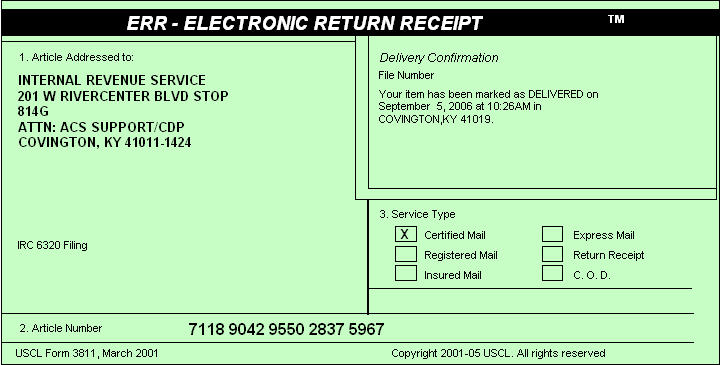
 On August 23, the IRS issued final regulations on how to establish evidence of document delivery when your documents don’t actually get delivered. Basically, you need to provide proof that you sent your papers to the IRS on time with registered/certified mail through the USPS or a private delivery service. According to the regulations, only proper use of registered or certified mail, or a service of a private delivery service will constitute prima facie evidence of delivery of documents. The final regulations apply to any payment or document mailed or delivered in an envelope with a postmark dated after Sept. 21, 2004 (not a misprint – 2004).
 That means no more midnight run to the post office seconds before the taxes are due. Your tax return may be considered as late filing, since now a good ole’ postmark technically isn’t “prima facie evidence” that you mailed your documents before the deadline.
You better cross your fingers and pray, when you stick that first-class stamp on your envelope, and send it with no additional proof of delivery services. So if your document gets delayed and past its due date, or the IRS never receives it at all, you’re pretty much out of luck.
On the Money,
Sufen Wang
Wang Solutions


 You can deduct any charitable donations you made during the year. Unfortunately, this does not include the time you spent doing laundry and taking the kids to school. Most charity organizations will issue a year-end summary of funds received from you by January 31. Any other small donations to Goodwill, Salvation Army, etc. must have a receipt with a description of the donated items and their estimated value.
 On the Year End,



























 Wang Solutions