Archive for September, 2018

Articles

Check Your Tax Withholdings!

In Accounting & Finances,Business,Taxes on September 24, 2018 by Sufen Wang

It’s Back to School for Everyone! Time to Do Your Tax Withholding Homework

School is starting up again, and while the little ones learn their ABC’s, you can check your paystub 123’s. Just like taxpayers with complex returns, if you have children or other dependents, you’ll want to give your withholding a review first thing. If you wait, you might end up learning your lesson too late, and be scrambling to find funds to pay down a bigger tax bill than you expected.

That’s why you should use the IRS.gov Withholding Calculator to test whether you’re having the right tax amount taken from your check each pay period. It’s way easier than any math exam you’ve ever had. All you need to do is fill in the blanks with your expected 2018 income, credits, deductions, etc., and then voila! you’ll automatically get your results and the IRS’s recommendations.

If you’re withholding too much each pay period, your Calculator message might say something along the lines of:

Based on the information you previously entered, your anticipated income tax for 2018 is $XXXX. If you do not change your current withholding arrangement, you will have $XXXX withheld for 2018 resulting in an overpayment of $XXX when you file your return. If you want your withholding to more closely match your anticipated tax, adjust your withholding on a new Form W-4 as follows…

But if you’re not withholding enough (AKA flunking this test), you might see:

Based on your responses, your anticipated income tax for 2018 is $XXXX. If you do not change your current withholding arrangement, you will have $XXX withheld for 2018 leaving $XXXX due when you file your return. To meet your anticipated tax of $XXXX change your current withholding arrangement by claiming X allowances plus an additional amount of $XXX for the balance of 2018. Here’s how…

Wait, why am I doing this again, you might be asking. Well, the recently implemented Tax Cuts and Jobs Act is likely to have some effect on what your correct withholding should be. So here’s a back-to-the-basics study guide of new tax law changes that could affect you if you’re a parent or a caretaker:


Personal Exemption

  • The personal exemption that you could formerly claim for yourself, your hubby/wife, and your dependents has been squashed, X’d out, erased from the chalkboard – so don’t plan on getting it. Even though the new tax law also increased the standard deduction, the loss of the personal exemption will likely hit families with 2 or more children hard.

Child Tax Credit – Luckily, some updates to the Child Tax Credit should soften the blow from the end of the personal exemption. Namely:

  • Instead of $1000, the maximum credit you can get is now $2000 per qualifying child.
  • If your income was previously too high to get in on that Child Tax Credit, you might find out that you qualify for it this year because:
    • The credit phases out now at $200,000 for singles and $400,000 for couples (last year was $75,000 for singles and $110,000 for couples).

Additional Child Tax Credit

  • The maximum additional child tax credit jumped from $1000 to $1400.
  • It’s also now a refundable credit if you’re all square on your owed federal income tax.


Credit for Other Dependents

  • If you support other dependents, there’s a brand new $500 credit up for grabs.
    • To get it, you’ll simply claim it when filing your tax return.
    • “Other” dependents include qualifying children or qualifying relatives, such as your kid at college (who you probably still tell “you can’t do that under my roof,” even though they’re off in their dorm), or an elderly parent (who probably still tells you “you can’t do that under my roof,” even though they’re living in your house).

As you can see, a lot has changed from last year’s tax laws. Even if you’re in the single file…r line, it’s a good idea to put on your thinking cap and figure out your withholding. Once you do this, you can sleep like a baby. Or you can stay up late like an adult at the university of life, reading more about withholding and the new tax laws on IRS.gov.

Sufen Wang, M.S. Accountancy
www.sufenwang.com
Wang Solutions, Long Beach, CA (562) 856-0793

Editor: Hannah Huff, M.F.A. Creative Writing: Poetry, (626) 806-5805


Articles

Check Your Check…

In Accounting & Finances,Business,Taxes on September 17, 2018 by Sufen Wang

Check Your Check: Avoid Tax Filing Surprises by Reviewing Your Withholding Now

Some surprises are great, like when a shirt rings up below the ticket price, or when your cat sneaks onto the sofa and purrs against your cheek.  Other surprises – not so great, like when your cat leaves you a mangled “gift” on the doorstep, or you get an unexpected tax bill or penalty when you file your 2018 income tax return.

While there’s no sure way to encourage good surprises in life, you can definitely avoid some bad ones. For example, if you’re a taxpayer with high income, a complex return, or someone who gets wages and also pays quarterly estimated taxes for self-employment, it’s a very very good idea check your withholding numbers NOW, in late-summer 2018, to avoid an unforeseen bill when you go to file in 2019.

This is especially important because “The Tax Cuts and Jobs Act” passed back in December of 2017 made some pretty big changes to the tax laws. A few of these include:

• Increasing the standard deduction (For 2018, it almost doubled to $24,000 for joint filers and $12,000 for single filers).
• Removing personal exemptions
• Limiting/discontinuing some deductions. For example—A $10,000 cap on deductions for state and local property, sales and income taxes;
• Changing tax rates and tax brackets

All in all, many taxpayers who itemized in days of yore might find out they’ll pay less tax in 2018 by taking the standard deduction. The key phrase here is “might find out” – it will literally pay off to know your numbers now to avert major complications when you file next year. Just give your paycheck a quick checkup to verify your withholding is in good health. For this DIY review, you’ll need just three things:

• The IRS’s Withholding Calculator
• Your completed 2017 tax return for estimates
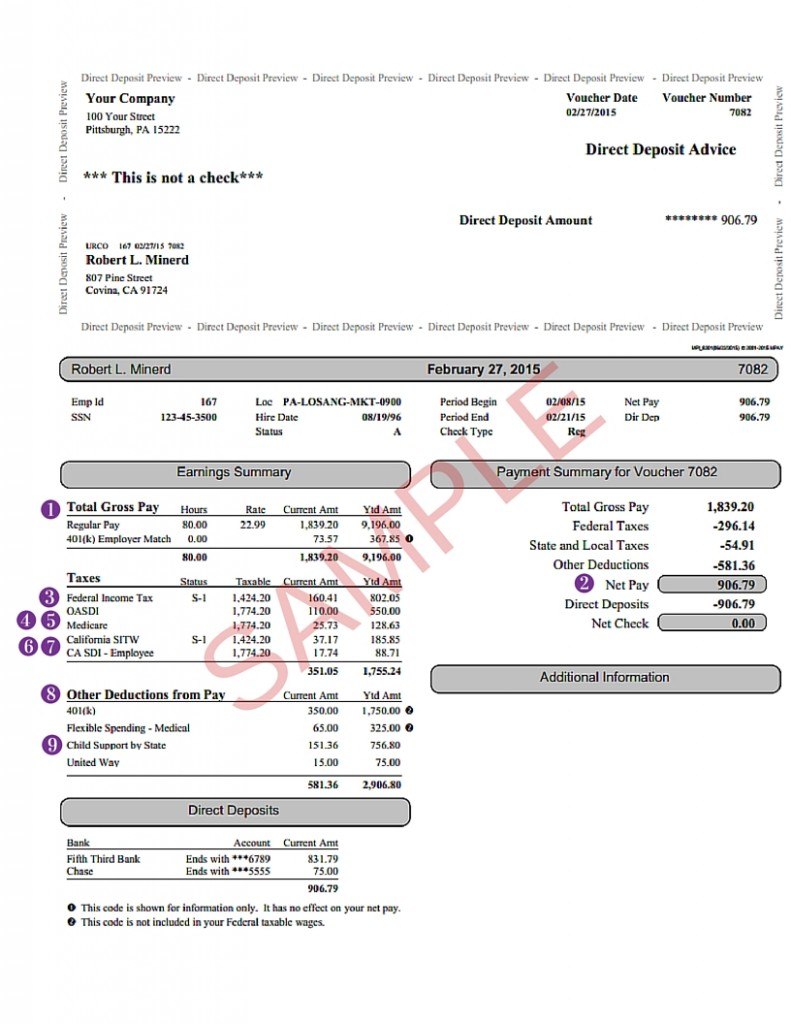
• Your most recent paystub

Following the calculator’s guidelines, check that you’re having the right amount of tax taken out of your pay. If your withholding is wonky, you should look into adjusting it ASAP by submitting a new Form W-4 to your employer. The longer you wait, the fewer pay periods you’ll have to withhold the correct amount, which means you’ll shell out a bigger chunk of change on each remaining paycheck. And if your withholding isn’t enough and you don’t make any adjustments this year, you’ll end up shelling out an even bigger chunk of change come tax return filing time.

Even if your withholding looks A-OK today, a change in your personal circumstances could shake things up before the year ends. For example, if you get a raise (yay you!) you should re-check your withholding. And if you do end up adjusting your withholding in mid-2018, you’re gonna’ wanna’ check it again come New Year’s, to make sure it’s still hunky dory for the full-year of 2019.

The IRS’s Withholding Calculator works fine for folks with simpler tax situations, but those of you out there with more elaborate stuff going on will want to take things to the next level with IRS Publication 505, Tax Withholding and Estimated Tax. For example, if you get non-wage income, such as capital gains, Pub. 505 will be your go-to info source. While it’s not as easy-breezy as the calculator, you do get worksheets and examples to help guide you through the maze of complex withholding.

Of course, while the Withholding Calculator and Publication 505 are helpful, but they can’t answer all of your tax-planning questions. If you need specific advice about the new tax laws and how they’ll affect your personal situation, get in contact with your friendly neighborhood tax professional. In the meantime, you can read more about withholding at http://www.irs.gov/withholding, and also get a head-start on prepping for next year’s taxes with IRS.gov/getready.

Remember, it pays off to expect the unexpected, especially with the ripple effects of new tax legislation likely to cause big waves in the filing season.

Sufen Wang, M.S. Accountancy
http://www.sufenwang.com
Wang Solutions, Long Beach, CA (562) 856-0793
Editor: Hannah Huff, M.F.A. Creative Writing: Poetry, (626) 806-5805


Articles

IRS Levy…Need More Time?!

In Accounting & Finances,Business,Taxes on September 10, 2018 by Sufen Wang

Clock Ticking on Challenging an IRS Levy? Now More Time is On Your Side

Taxpayers may be singing a new tune this year along the lines of “I fought the law and the law…didn’t win because I now have more time to challenge a levy!” It doesn’t have quite the ring of the original song, but it does bode well for individuals and businesses who think they’ve been hit with a wrongful IRS levy or seizure. Based on new legislation, the time limit to file an admin claim/bring civil action jumped from 9 months to 2 years, granting extra time to either procrastinate or make your case known.

A CRASH course in levies: if you have an outstanding tax debt, it doesn’t just slink away. The IRS can place a levy, which makes it perfectly legal for your property to be seized and sold to satisfy your debt, never to be seen by you again. Yes, your car, your house, and your boat are up-for-grabs, along with wages, and moolah in the bank and other financial accounts.

But wait, there’s a twist! Even if the IRS already sold your levied property, you can get it back – and that’s the scenario where the extended 2-year period comes into play. If – and only if – your property was already hocked, you get 24 whole months from the levy date to file an administrative claim to get your stuff back. The IRS points out that, “Usually, wrongful levy claims involve situations where an individual or business believes that either the property belongs to them, or they have a superior claim to the property that the IRS is not recognizing.”

But wait, there’s another twist! If you do make an administrative claim within the extended 2-year period, you score another extension. Depending on which is shorter, the 2-year period for bringing suit is extended for either:

  • 12 months from the date you filed the claim; OR
  • 6 months from the date the IRS disallowed the claim.

All this only applies to levies made before, on, or after 12/22/17, as long as the previous 9-month period hasn’t expired. Remember that if the IRS still has the property it levied, there’s no time limit for filing that claim – through the motto “sooner is better than later” is always apt.

But wait, there’s one more twist that could spare you the trouble of the prior twists. Anyone who gets the IRS bill, “Final Notice of Intent to Levy and Notice of Your Right to A Hearing,” should immediately get in touch with the IRS. Even at this ultra-super-late-final-notice-why-did-you-wait-so-long-stage, you still might be able to make arrangements to pay your tax liability, instead of having the IRS go to town with a levy.

There are lots of opportunities to clear your tax debt before the IRS comes a-knockin’ for your property. However, if it gets to the point where they’ve already confiscated your belongings, at least now you have a little extra time to get your stuff together to submit that administrative wrongful levy claim to get your stuff back.

Sufen Wang, M.S. Accountancy
www.sufenwang.com
Wang Solutions, Long Beach, CA (562) 856-0793

Editor: Hannah Huff, M.F.A. Creative Writing: Poetry, (626) 806-5805